

Social media gets the headlines, but email quietly outperforms it where it counts. Australian automated campaigns hit a 29.5% open rate, 4.2% click-through rate, and 2.8% conversion rate, numbers most paid social campaigns can only dream about. Yet many Australian business owners still treat email as a secondary channel, something to bolt on after the "real" marketing is done. That thinking is costing them revenue. This guide breaks down exactly why email marketing deserves a front-row seat in your strategy, and how to make it work harder for your business in 2026.
Table of Contents
- The role of email marketing in Australia's digital landscape
- How email marketing outperforms other channels
- Beyond the inbox: Email marketing as a relationship system
- Steps to maximize your email marketing investment
- Why most businesses undervalue email—and what truly smart marketers do
- Ready to elevate your email marketing results?
- Frequently asked questions
Key Takeaways
| Point | Details |
|---|---|
| Superior conversion rates | Email marketing consistently drives higher conversion and engagement than social media or paid search in Australia. |
| Revenue and growth | Australia’s email marketing market is expanding rapidly, reaching A$1.75B in 2026. |
| Long-term value | Treating email as a relationship platform brings much higher customer lifetime value. |
| Actionable steps | A strategic approach—automation, segmentation, testing—maximizes ROI from email marketing. |
The role of email marketing in Australia's digital landscape
Email marketing is not a relic from the early internet. It is one of the fastest-growing revenue channels in the country right now. Australia's email marketing revenue is projected to hit A$1.75 billion in 2026, a figure that reflects genuine market momentum, not nostalgia.
So why does email keep growing while other channels fight for scraps of attention? Three reasons stand out.
- Direct access: Your email lands in a subscriber's inbox without competing in a social feed or bidding against a rival's ad spend.
- Relationship building: Email lets you communicate at every stage of the customer journey, from welcome sequences to post-purchase follow-ups.
- Automation at scale: Modern platforms let you trigger personalized messages based on behavior, purchase history, or time since last engagement, without manual effort.
Think of social media and paid search as the top of your funnel. They introduce your brand to new audiences. Email is where you convert that attention into revenue and keep customers coming back. The two approaches are complementary, not competing.
"Email is the only channel you own outright. No algorithm can cut your reach overnight."
For Australian businesses building a sustainable marketing engine, email marketing strategies that prioritize segmentation and automation are quickly becoming the standard, not the exception. And as you think about how email fits into your broader presence, consider how it reinforces your digital brand identity by delivering consistent, on-brand communication directly to your most engaged audience.
The channel rewards consistency. Businesses that show up regularly in the inbox, with relevant content and genuine value, build the kind of trust that converts into long-term customer relationships.
How email marketing outperforms other channels
Beyond its growth, email marketing's true advantage becomes clear when measured against other digital channels. The numbers are not even close.
| Channel | Conversion rate | Cost efficiency | Algorithm risk |
|---|---|---|---|
| Email marketing | ~4% | High | None (owned) |
| Social media | ~0.59% | Medium | High |
| Paid search | Variable | Lower ROI | Medium |
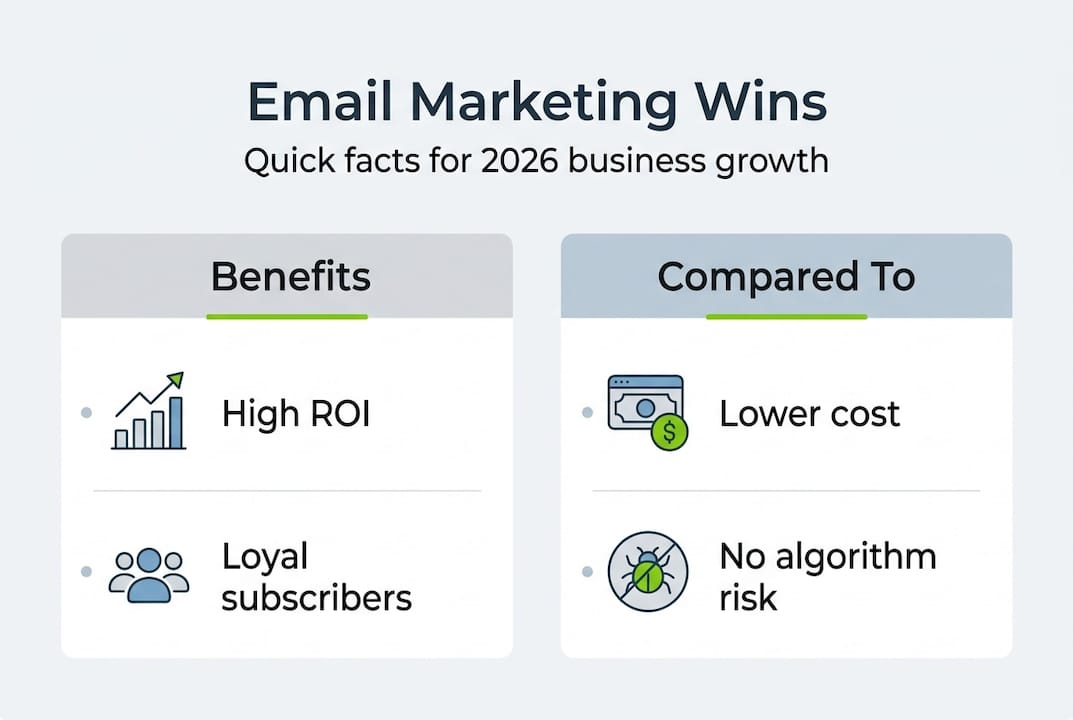
Email delivers 4x higher conversion rates than social media and generates $2 in return for every $1 spent, outpacing paid search on a cost-per-acquisition basis. Social media's average conversion rate sits at just 0.59%, meaning email converts at roughly seven times the rate.
Here is why the gap keeps widening:
- Ownership: Your email list is an asset you control. A social platform can change its algorithm tomorrow and cut your organic reach by 80%. Your subscriber list stays yours.
- Intent: People who opt into your emails have already signaled interest. That warm audience converts far more readily than cold paid traffic.
- Compounding returns: Every subscriber you retain compounds in value over time. A customer who buys twice is worth exponentially more than one who buys once.
- Personalization at low cost: Segmenting your list and sending targeted offers costs almost nothing extra, unlike paid channels where targeting more precisely usually means spending more.
The benefits of AI in marketing ROI are amplifying this further. AI-powered tools now help marketers predict send times, generate subject line variants, and identify which segments are most likely to convert, pushing email performance even higher.

Pro Tip: Do not choose between email, social, and SMS. Use social and paid ads to grow your list, then use email and SMS to convert and retain. That full-funnel combination consistently outperforms any single channel used in isolation.
Beyond the inbox: Email marketing as a relationship system
To realize email's full value, mindset and measurement must shift from simple broadcasts to building lasting relationships. Most businesses measure email success by open rates alone. High performers measure something more meaningful: revenue per subscriber, or RPS.
Top-performing email programs generate between $3 and $8 in monthly revenue per subscriber, a benchmark that reframes your entire list as a revenue asset rather than a contact database. When you think in RPS terms, every decision, from list hygiene to content quality, becomes a business decision with a dollar value attached.
| Metric | Average program | Top performer |
|---|---|---|
| Monthly RPS | Under $1 | $3 to $8 |
| List churn rate | 2 to 3% monthly | Under 1% |
| Repeat purchase rate | 20 to 30% | 50%+ |
Shifting to a relationship-first model means thinking in journeys, not campaigns. Instead of blasting your whole list with a promotion, you map out what each subscriber needs at each stage.
- New subscribers: Welcome series that introduces your brand, sets expectations, and delivers immediate value.
- Active buyers: Post-purchase sequences that encourage reviews, upsells, and referrals.
- Dormant subscribers: Re-engagement campaigns with a compelling reason to come back, or a clean unsubscribe if they are truly gone.
This lifecycle approach, guided by strategies for higher ROI, is what separates businesses with flat email revenue from those seeing consistent month-over-month growth.
Pro Tip: Audit your current email program and ask: are we sending one-off promotions, or are we guiding subscribers through a journey? The answer will tell you exactly where your biggest revenue opportunity is hiding.
Steps to maximize your email marketing investment
With a relationship-first approach, let's detail the practical steps for amplifying your email marketing impact. The good news is that most of these steps cost more time than money.
- Audit your current list: Remove invalid addresses, identify inactive segments, and check your deliverability score. A clean list improves open rates immediately.
- Segment by behavior: Group subscribers by purchase history, engagement level, or product interest. Relevant emails outperform generic blasts every time.
- Automate the essentials: Set up welcome sequences, abandoned cart reminders, and post-purchase follow-ups. These run 24/7 and generate revenue without ongoing effort.
- Personalize beyond first name: Use dynamic content blocks to show different offers or product recommendations based on what each subscriber has browsed or bought.
- Test systematically: Run A/B tests on subject lines, send times, and call-to-action buttons. Small improvements compound significantly over thousands of sends.
- Analyze and iterate: Track RPS, not just opens. Review what drove revenue each month and double down on what worked.
Automation is the single biggest lever most businesses are not pulling hard enough. Australian automated campaigns already outperform manual sends on every key metric, 29.5% open rate, 4.2% CTR, and 2.8% conversion rate, yet many businesses still rely on manual, one-off sends.
Easy wins to implement this week:
- A three-email welcome series for new subscribers
- A two-email abandoned cart sequence triggered 1 hour and 24 hours after abandonment
- A win-back campaign for subscribers inactive for 90 days
- A post-purchase sequence requesting a review and offering a related product
Pro Tip: Consistent testing beats occasional optimization. Schedule a monthly review of your top-performing and worst-performing emails. Patterns emerge fast, and acting on them is how you drive higher ROI with email quarter after quarter.
Why most businesses undervalue email—and what truly smart marketers do
Here is the uncomfortable truth: most businesses treat email as a last-minute channel. A campaign goes out when someone remembers to send one, the list never gets cleaned, and automation is limited to a basic welcome email set up years ago. Then they wonder why results are flat.
High-performing email programs look completely different. They plan customer journeys months in advance, invest in list quality over list size, and treat every automation as a living asset to be tested and improved. They also measure what matters. Email's compounding lifetime value is 2.5 to 3 times higher than social media, yet most marketing budgets still favor paid ads because the results are more immediately visible.
The marketers who consistently beat the average are the ones beating the ROI average by treating email as a strategic asset, not a tactical afterthought. They build retention systems, not just acquisition campaigns. Active retention, meaning keeping existing customers engaged and buying again, is where email's real financial leverage lives. Acquiring a new customer costs five times more than retaining one. Email is your most cost-effective retention tool, if you use it with intention.
Ready to elevate your email marketing results?
If reading this has made you realize your email program has untapped potential, you are not alone. Most Australian businesses are leaving significant revenue on the table simply because their email strategy has not kept pace with what is now possible.
At WebRise, we work with Australian business owners and marketing teams to build email programs that actually move the needle. From strategy and automation setup to ongoing optimization and full-funnel integration, we tailor every approach to your specific audience and goals. No generic templates, no guesswork. If you are ready to turn your email list into a consistent revenue engine, let's talk about what a tailored email marketing audit could reveal for your business.
Frequently asked questions
Does email marketing really work better than social media in Australia?
Yes, email marketing delivers up to 4x higher conversion rates than social media and is not affected by platform algorithm changes, making it a more reliable revenue channel for Australian businesses.
What open and click rates should I expect from Australian email campaigns?
Automated email campaigns in Australia average a 29.5% open rate, a 4.2% click-through rate, and a 2.8% conversion rate, which are strong benchmarks to measure your own program against.
How does email marketing's ROI compare to paid search?
Email marketing generates $2 per $1 spent, typically outperforming paid search on a cost-per-acquisition basis, especially when automation and segmentation are used effectively.
Is email marketing still growing in Australia?
Yes, Australian email marketing revenue is projected to reach A$1.75 billion in 2026, reflecting strong and continued growth across the market.