

Most Australian businesses treat email marketing like a megaphone: point it at your list, blast a message, and hope something sticks. That approach is costing you money. Modern email marketing is a precision instrument, and when you build it around data, segmentation, and automation, the results are dramatic. Personalized campaigns deliver 122% higher ROI than generic ones. This guide walks you through the full picture: what a real email strategy looks like, how to build one, what Australian law requires, and how to measure what actually matters.
Table of Contents
-
Defining email marketing strategy: More than sending campaigns
-
Driving measurable results: ROI, personalization, and automation
-
A smarter path: Why revenue, not opens, is your key metric in 2026
Key Takeaways
| Point | Details |
|---|---|
| Strategy beats campaign | Having an email marketing strategy delivers better engagement and results than sending generic campaigns. |
| Compliance is critical | Australian law requires consent, clear sender ID, and timely unsubscribe processing to avoid severe penalties. |
| Personalization drives ROI | Emails tailored to segments and automated journeys deliver up to 122% higher ROI. |
| Measure what matters | Focus on revenue per send and conversions, not just open rates, for long-term business success. |
Defining email marketing strategy: More than sending campaigns
A lot of businesses confuse email marketing with email sending. They schedule a newsletter, hit send, and call it a strategy. That is not a strategy. That is a habit.
A true comprehensive email marketing plan is something far more structured. As Braze defines it, “An email marketing strategy is a comprehensive, always-on plan outlining goals, audience segmentation, content, timing, channel coordination, testing, and optimization to drive business outcomes like engagement, retention, and revenue.” Every word in that definition matters.
The difference between a generic campaign and a strategic one is not just about better copy. It is about the system behind the message.
Generic campaigns vs. strategic campaigns
| Element | Generic campaign | Strategic campaign |
|---|---|---|
| Audience | Full list | Segmented by behavior |
| Content | Same for everyone | Personalized by lifecycle stage |
| Timing | Fixed schedule | Triggered by user action |
| Measurement | Open rate | Revenue per send |
| Optimization | Rarely tested | Continuous A/B testing |
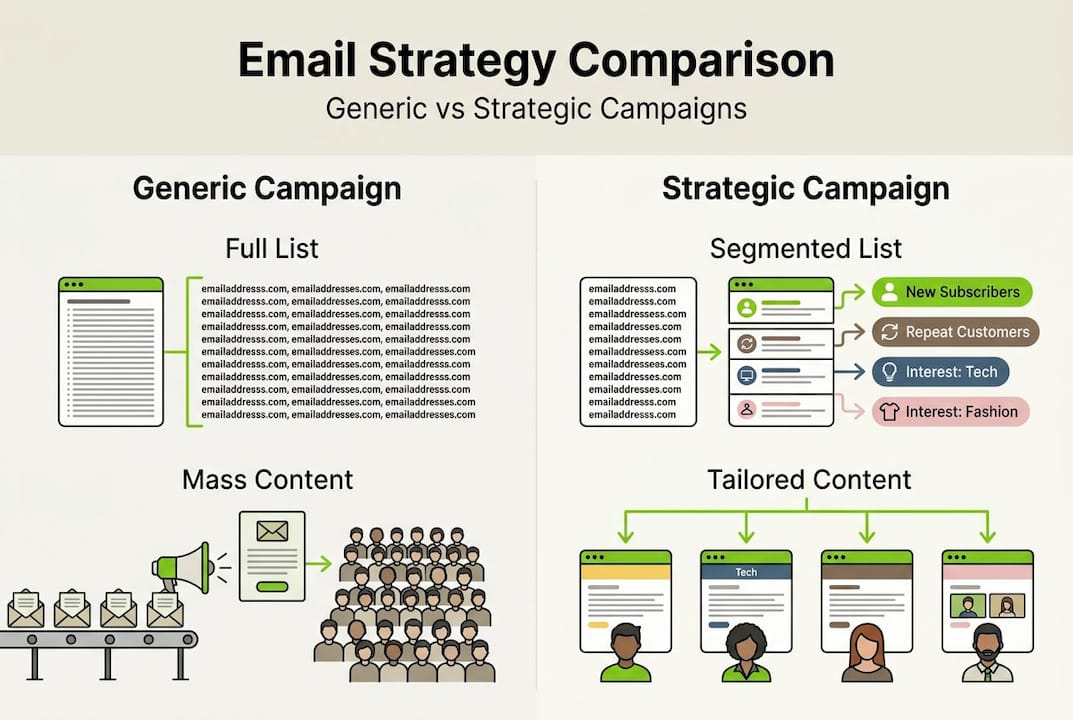
Strategic email marketing treats every send as a business decision. You are not just filling an inbox. You are moving someone along a journey from stranger to loyal customer.
Here are the core pillars that separate a strategy from a campaign schedule:
-
Goals: What business outcome does each email serve? Acquisition, retention, or revenue?
-
Segmentation: Who receives this message, and why are they the right audience?
-
Content: Does the message match the recipient’s stage in the buying journey?
-
Timing: Is the email triggered by behavior, or just sent on a fixed day?
-
Testing: Are you running A/B tests to improve subject lines, CTAs, and send times?
-
Optimization: Are you using data from past sends to improve future ones?
“The biggest mistake marketers make is treating email as a broadcast channel. The most effective email programs treat it as a conversation, one that evolves based on what the data tells you about each subscriber.”
When you build email around these pillars, you stop guessing and start growing.
Core components of a winning email strategy
Now that you understand what a strategy actually is, let us look at how to build one that delivers results. The email strategy methodologies that consistently outperform others share five core components.
-
Set lifecycle goals: Define what you want email to achieve at each stage. Acquisition emails bring in new subscribers. Activation emails turn them into first-time buyers. Retention emails keep them coming back. Revenue emails drive upsells and repeat purchases.
-
Build segments using first-party data: First-party data is information your customers give you directly, through purchases, browsing behavior, or form submissions. Use it to group subscribers by behavior, not just demographics. A customer who bought last week needs a different message than one who has not opened an email in six months.
-
Automate key journeys: Welcome sequences, cart abandonment emails, and win-back campaigns should run without manual effort. Automation means the right message reaches the right person at the right moment, every time.
-
Ensure deliverability: SPF, DKIM, and DMARC are email authentication protocols that tell inbox providers your emails are legitimate. Without them, your messages end up in spam. Consent management is equally important, especially under Australian law.
-
Measure what moves the needle: Open rates are easy to track but hard to act on. Revenue per send and conversion rates tell you whether your emails are actually driving business.
Email performance benchmarks
| Metric | Industry average | Top performers |
|---|---|---|
| Open rate | 20 to 25% | 35 to 45% |
| Click-through rate | 2 to 3% | 5 to 8% |
| Conversion rate | 1 to 2% | 3 to 5% |
| Revenue per send | $0.08 to $0.15 | $0.30 to $0.60 |
Pro Tip: Do not wait until your list is large to set up automated journeys. Even a list of 500 subscribers benefits from a well-built welcome sequence. Automation scales with you, so build it early.
Australian compliance: Navigating the Spam Act in strategy
Compliance is not optional in Australia, and it is not just a legal checkbox. The rules around email marketing directly shape how you build your list, structure your campaigns, and manage your audience.
The Australian email regulations under the Spam Act 2003 apply to both B2B and B2C communications with an Australian connection. Here is what you must have in place:
-
Consent: Every recipient must have given either express consent (they actively opted in) or inferred consent (there is a clear existing business relationship). Buying a list does not count.
-
Sender identification: Every email must clearly identify who sent it. Your business name, trading name, or ABN must be visible.
-
Functional unsubscribe link: Every email must include a working unsubscribe mechanism. The request must be processed within 5 business days and the unsubscribe link must remain active for 30 days after the email is sent.
-
Record keeping: You need to be able to prove consent was given, especially if a complaint is made.
The penalties for breaching the Spam Act are serious. Fines can reach AUD $2.2 million per day for serious or repeated Spam Act breaches. That is not a fine that any business, large or small, can afford to ignore.
Compliance also protects your sender reputation. When recipients mark your emails as spam, inbox providers take notice. A damaged sender reputation means lower deliverability, which means fewer people see your emails, which means lower ROI. Compliance and performance are directly linked.
Pro Tip: Audit your consent records at least once per quarter. Check that your unsubscribe links are working, your sender details are current, and your list hygiene is up to date. A 30-minute audit can prevent a million-dollar problem.
Driving measurable results: ROI, personalization, and automation
Once your strategy is built on solid foundations and your compliance is locked in, the focus shifts to performance. And the numbers here are genuinely compelling.

Global email ROI benchmarks show returns of $36 to $45 for every $1 spent. Around 35% of marketing leaders report $10 to $36 ROI, while 30% achieve $36 to $50. For Australian marketing teams, this positions email as one of the highest-returning channels available, well ahead of most paid media.
But those averages mask a significant gap between businesses that personalize and those that do not.
“Personalized emails do not just perform better. They perform dramatically better. Businesses that invest in behavioral segmentation and dynamic content see ROI figures that generic senders cannot match.”
The data backs this up. Personalized emails deliver 122% higher ROI than non-personalized campaigns. Automation takes it even further, with automated email programs generating 30x higher ROI compared to manual sends.
Here are the most effective steps to boost your email ROI right now:
-
Segment by purchase history: Customers who bought in the last 30 days respond differently than lapsed buyers. Treat them differently.
-
Use dynamic content blocks: Show different product recommendations or offers based on what each subscriber has browsed or bought.
-
Build a post-purchase sequence: The period right after a purchase is when trust is highest. Use it to upsell, gather reviews, or introduce loyalty programs.
-
Reactivate dormant subscribers: A well-crafted win-back campaign can recover 10 to 15% of inactive subscribers before you remove them from your list.
-
Test everything: Subject lines, send times, CTA placement, and email length all affect performance. Small improvements compound over time.
Pro Tip: Stop reporting to your team on open rates alone. Replace that metric with revenue per send. It forces every campaign decision to connect back to business outcomes, not just inbox activity.
A smarter path: Why revenue, not opens, is your key metric in 2026
Here is the uncomfortable truth most email marketing guides will not say directly: open rates are almost meaningless in 2026.
Apple’s Mail Privacy Protection, Gmail’s tab sorting, and inbox competition across the APAC region have made open rates unreliable as a performance signal. You can have a 40% open rate and a campaign that generates zero revenue. That is not success.
Data-driven strategies that consistently outperform the market prioritize revenue per send and click-through rate over opens. They also integrate AI across the workflow, from subject line generation to send-time optimization to predictive segmentation. This is not a future capability. It is available now, and Australian businesses that ignore it are leaving measurable revenue on the table.
The APAC email marketing benchmarks for 2026 show that the gap between data-driven programs and traditional ones is widening. Australian marketers have a unique challenge: layering Spam Act compliance on top of global best practices. But that challenge is also an advantage. Businesses that build compliant, permission-based lists tend to have higher engagement because every subscriber actually wants to hear from them.
Shift your team’s reporting dashboard today. If revenue per send is not on it, you are optimizing for the wrong thing.
Turn strategy into action with expert support
Building a high-performing email strategy takes more than the right tools. It takes a clear plan, compliant processes, and ongoing optimization based on real data. Most Australian businesses have the ambition but not the bandwidth to execute all of it well.
At WebRise, our team of digital marketing experts builds email programs from scratch, tailored to your audience, your compliance obligations, and your revenue goals. We combine behavioral segmentation, automation, and AI-driven optimization to deliver campaigns that perform. Whether you are starting from zero or rebuilding a program that has gone stale, we can help you turn email into one of your strongest revenue channels.
Frequently asked questions
What makes an email marketing strategy different from sending campaigns?
An email marketing strategy is a comprehensive, always-on plan that includes segmentation, automation, compliance, and measurement, not just campaign scheduling. It connects every send to a specific business outcome.
What are the legal requirements for email marketing in Australia?
The Spam Act 2003 requires consent from every recipient, clear sender identification, and a functional unsubscribe link that is processed within 5 business days. Penalties for breaches can reach AUD $2.2 million per day.
How is ROI measured in email marketing?
ROI is calculated by the revenue generated per dollar spent on email, with top benchmarks ranging from $36 to $45 returned for every $1 invested. Revenue per send is the most actionable metric for ongoing optimization.
Why are personalization and automation important in email strategy?
Personalized emails deliver 122% higher ROI than generic campaigns, and automation can boost results by up to 30 times compared to manual sends. Both reduce effort while increasing relevance for each subscriber.
What metrics should Australian marketers focus on for email success?
Clicks and revenue per send are more actionable than open rates, which have become unreliable due to inbox filtering and privacy changes. Data-driven strategies that prioritize revenue metrics consistently outperform those focused on open rates alone.