

Most Australian small businesses know branding matters. Yet only 16% plan to increase their investment in it. That gap between recognition and action is where competitors quietly pull ahead. The good news is that AI-driven tools have fundamentally changed the cost and complexity of building a strong digital brand identity. You no longer need a big agency retainer or a full-time designer to look credible online. This guide walks you through why digital branding matters for Australian SMBs, which tools to use, how to execute your strategy, and how to keep it sharp over time.
Table of Contents
- Why digital brand identity matters for Australian SMBs
- Preparation: Essential tools and AI resources
- Execution: Step-by-step guide to building your brand identity
- Verification: Consistency and ongoing optimization
- Fresh perspective: AI's real power and pitfalls in branding
- Take your digital brand further with WebRise
- Frequently asked questions
Key Takeaways
| Point | Details |
|---|---|
| Brand identity boosts SMB competitiveness | A strong digital identity delivers visibility, trust, and customer loyalty for Australian SMBs. |
| AI makes branding affordable | AI-driven platforms enable professional logo and content creation, saving business owners hundreds to thousands. |
| Consistency and human strategy matter | Regular brand reviews and blending AI with authentic messaging maintains relevance and uniqueness. |
| Professional support accelerates results | Partnering with a digital marketing agency helps refine and execute branding strategies more effectively. |
Why digital brand identity matters for Australian SMBs
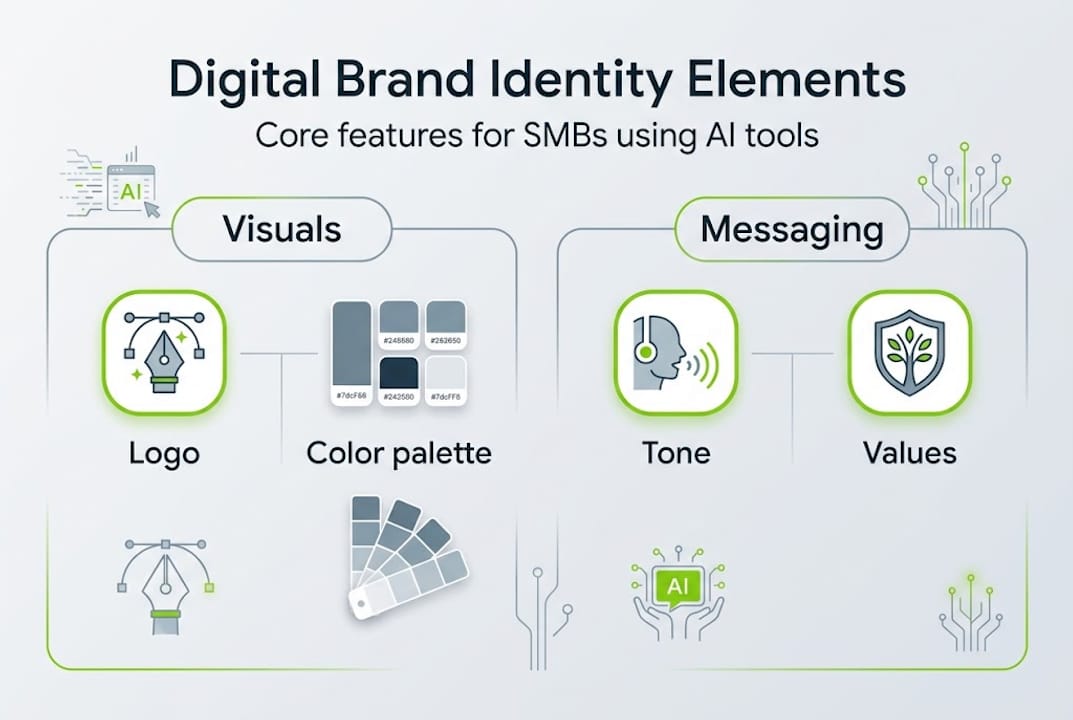
Your digital brand identity is the sum of everything a customer sees, reads, and feels when they encounter your business online. It includes your logo, color palette, tone of voice, website design, and social media presence. Together, these elements shape whether a potential customer trusts you enough to take the next step.
For Australian SMBs, the stakes are real. 81% of Australian businesses view branding as a competitive advantage, yet only 42% actively prioritize brand building. That means the majority of your competitors recognize the value but are not acting on it. That is your window.
Consistency is the single most underrated factor in digital branding. When your visuals, messaging, and tone align across every platform, customers develop familiarity. Familiarity builds trust. Trust drives conversions. It really is that straightforward.
Here is a quick comparison of what strong versus weak digital brand identity looks like in practice:
| Element | Strong brand identity | Weak brand identity |
|---|---|---|
| Logo | Consistent across all platforms | Different versions on each channel |
| Tone of voice | Recognizable and on-brand | Inconsistent or generic |
| Color palette | Defined and applied uniformly | Random or mismatched |
| Messaging | Clear value proposition | Vague or confusing |
| Customer trust | High, built over time | Low, hard to rebuild |
For SMB branding insights specific to the Australian market, the data tells a clear story. The businesses that invest in a defined digital identity consistently outperform those that treat branding as an afterthought.
Key reasons Australian SMBs should prioritize digital brand identity right now:
- Increased online competition means first impressions happen faster than ever
- Mobile search behavior means your brand must communicate value within seconds
- AI-powered search tools are now surfacing brands based on consistency and authority signals
- Customer loyalty is harder to earn and easier to lose without a recognizable identity
Building your brand is not a one-time project. It is an ongoing investment that compounds over time, and the earlier you start, the greater the return.
Preparation: Essential tools and AI resources
Once you understand the value of digital branding, the next step is assembling the necessary tools and assets. The barrier to entry has dropped significantly. AI tools have made professional-quality branding accessible to businesses that previously could not afford it.
Traditionally, a custom logo and brand kit from a designer would cost anywhere from $500 to $5,000. Today, AI-designed logos can be created in minutes, saving between $100 and $2,000 depending on complexity. That is not a minor efficiency gain. For a small business watching every dollar, it is transformative.

Here is a practical overview of the tools worth knowing:
| Tool | Primary use | Cost range |
|---|---|---|
| Adobe Express | Logo, social graphics, brand kits | Free to $55/month |
| Canva | Visual content, templates, brand hub | Free to $22/month |
| ChatGPT | Messaging, tone of voice, copy | Free to $30/month |
| Looka | AI logo generation | One-time $65-$80 |
| Brandmark | Logo and brand identity | One-time $25-$65 |
Beyond tools, you need to establish three core brand assets before anything else:
- Logo and visual identity: Your logo should work in multiple formats, color and monochrome, large and small
- Color palette: Choose two to four colors that reflect your brand personality and use them everywhere
- Brand messaging: Write a one-sentence value proposition that clearly explains what you do and who you serve
Pro Tip: Before using any AI tool, write down three words that describe how you want customers to feel when they interact with your brand. Feed these words into every AI prompt you use. It keeps the output aligned with your actual brand values rather than producing something generic.
The way automation and branding blend most effectively is when you treat AI as a production accelerator, not a strategy replacement. Use it to execute faster, not to think for you.
Execution: Step-by-step guide to building your brand identity
With tools in hand, it is time to take action and build your distinct digital brand. The process is more structured than most people expect, and skipping steps early creates expensive problems later.
Follow these steps in order:
- Define your brand fundamentals. Write down your mission, your target customer, your core values, and your tone of voice. These are your brand's operating system. Everything else runs on top of them.
- Create your visual identity. Use an AI tool like Looka or Adobe Express to generate logo concepts. Select one direction and refine it. Export your final logo in SVG, PNG, and JPEG formats.
- Build your brand style guide. Document your colors (with hex codes), fonts, logo usage rules, and tone of voice guidelines. Even a one-page document is enough to start.
- Apply your identity across all platforms. Update your website, Google Business Profile, social media accounts, and email signature with consistent visuals and messaging.
- Create a content template library. Build reusable templates in Canva or Adobe Express for social posts, email headers, and promotional graphics.
- Test your messaging. Share your value proposition with five real customers and ask if it resonates. Adjust based on their feedback before scaling.
"Businesses that used AI tools to develop their brand identity reported 22 to 35% engagement lifts compared to those using manual-only approaches."
The most common mistake at this stage is inconsistency. A business will nail the website design but use a completely different visual style on Instagram. Customers notice this, even if they cannot articulate why it feels off.
Pro Tip: Set a recurring monthly calendar reminder to do a quick brand audit. Open your website, Instagram, Facebook, and Google Business Profile side by side and check that the logo, colors, and bio copy all match.
For unique branding outcomes, the businesses that stand out are those that blend AI efficiency with a genuinely human point of view. Your brand story, your values, your specific customer relationships — those cannot be automated.
Verification: Consistency and ongoing optimization
After crafting your identity, the next task is to ensure it is effectively maintained and enhanced over time. Building the brand is step one. Keeping it consistent is the ongoing work that most businesses underestimate.
The data supports this challenge. Only 55% of businesses report having consistent branding across all touchpoints, while 55% say they are open to using AI to improve their brand presence. Openness is not enough. You need a system.
Use this checklist every quarter to verify brand consistency:
- Website: Does your homepage clearly communicate your value proposition within five seconds?
- Social media profiles: Are your bio, profile image, and cover photo consistent across platforms?
- Google Business Profile: Is your business description, logo, and contact information current?
- Email communications: Do your email templates match your brand colors and tone?
- Customer touchpoints: Do your invoices, proposals, and follow-up messages feel like they come from the same brand?
"Brand consistency is not a design problem. It is a systems problem. The businesses that maintain it are the ones that build it into their processes, not their intentions."
AI analytics tools can help you go further. Google Analytics 4 tracks how users engage with your content. Tools like Semrush or Ahrefs show how your brand is being discovered in search. Sentiment analysis tools can surface how customers talk about your brand in reviews and social comments.
For ongoing digital brand optimization, the goal is to treat your brand as a living system. Set a formal review every six months. Look at what is working, what has drifted, and what needs updating based on new market realities or business direction.
The businesses that grow fastest are not the ones with the most creative branding. They are the ones that show up the most consistently.
Fresh perspective: AI's real power and pitfalls in branding
Here is something most branding guides will not tell you: AI can make your brand look worse if you use it without a clear strategy. The tools are powerful, but they are trained on patterns. Left unchecked, they produce outputs that look polished but feel empty.
We have seen Australian SMBs invest in AI-generated logos, AI-written bios, and AI-designed social templates, only to end up with a brand that looks exactly like their competitors. The aesthetic is clean, but there is no personality. No story. Nothing that makes a customer feel anything.
The blend of AI with human strategy is where the real advantage lives. Use AI to execute faster and cheaper. Use human judgment to decide what your brand actually stands for and how it should make people feel.
The businesses that win with AI-driven branding are the ones that feed it with genuinely specific inputs. Specific values. Specific customer stories. Specific language that comes from real conversations with real clients. Generic AI outputs come from generic prompts. The quality of what you put in determines the quality of what comes out.
AI is a production tool. Strategy is still a human job.
Take your digital brand further with WebRise
Building a digital brand identity takes clarity, consistency, and the right tools working together. If you have been putting it off because it felt too complex or too expensive, the AI-driven approaches in this guide show that neither barrier holds anymore.
WebRise works with Australian SMBs to build brand identities that are not only visually strong but strategically aligned with how customers search, discover, and decide. As digital marketing experts based in Sydney, we tailor every brand strategy from scratch, using AI tools and human insight together. Whether you need help defining your brand fundamentals or executing across every digital channel, we are ready to work with you. Reach out to WebRise and take the next step toward a brand that genuinely stands out.
Frequently asked questions
How can AI tools help small businesses build a digital brand identity?
AI tools automate design and content creation, enabling professional-quality branding at a fraction of traditional costs. Logos created in minutes can save SMBs between $100 and $2,000 compared to hiring a designer.
What are the most important elements of a strong digital brand identity?
Consistent visuals, clear messaging, and authentic values form the foundation of effective digital branding. Only 55% of businesses currently maintain consistent branding across all touchpoints, which means getting this right is a genuine competitive edge.
How often should I review and update my brand identity?
Review your brand identity every six to twelve months, or after any significant business or market change. Periodic brand reviews are essential for maintaining consistency as your business evolves.
Is it possible to blend AI and manual strategy effectively?
Yes, and it is actually the most effective approach available to SMBs today. Using AI for design execution and human insight for messaging and values delivers stronger, more unique results than either approach alone.