

Choosing the right digital marketing channels feels like standing in front of a menu with 50 options and no idea what you actually need. For Australian business owners and marketing managers, the stakes are real: pick the wrong mix and you burn budget with nothing to show for it. The good news is that the core types of digital marketing, including SEO, PPC, content, social media, email, and the emerging category of AI-powered generative engine optimization (GEO), each have measurable strengths. This guide walks you through how to evaluate, select, and combine them for the best possible return.
Table of Contents
- How to choose the right digital marketing mix
- Search engine marketing (SEO & PPC)
- Content marketing and thought leadership
- Social media and influencer marketing
- Email marketing and lifecycle automation
- Comparison of digital marketing types for Australian businesses
- Why AI-driven innovation won't replace marketing fundamentals
- Level up your marketing with expert support
- Frequently asked questions
Key Takeaways
| Point | Details |
|---|---|
| Prioritize ROI leaders | SEO, PPC, and email consistently deliver top results for Australian businesses. |
| Balance human and AI | AI enhances performance but human expertise is key for strategic content and brand credibility. |
| Diversify your mix | Combine search, social, email, and content marketing for the most resilient strategy. |
| Set clear KPIs | Define and measure outcomes for each channel to optimize digital marketing investments. |
How to choose the right digital marketing mix
Before you spend a dollar, you need a framework. Not every channel works equally well for every business, and the Australian market has its own dynamics that affect what delivers results.
Start by asking four questions about each channel you consider:
- Who is your audience? LinkedIn works for B2B; Instagram works for lifestyle brands. Matching platform to buyer behavior is non-negotiable.
- What is your time horizon? SEO takes 6-12 months to compound. Google Ads can generate leads in 48 hours. Your cash flow reality should shape the mix.
- How will you measure success? If you cannot track it, you cannot optimize it. Every channel needs a clear KPI from day one.
- What does the Australian market data say? Australian SMEs allocate 12-18% of revenue to digital marketing, with 30-40% directed toward search. That tells you where proven spend is concentrated.
Once you have answered those questions, think about how AI fits in. AI tools like ChatGPT and Google AI do not replace channel strategy; they accelerate execution. Using AI to sharpen audience targeting, generate content variations, or analyze campaign data can lift performance across every channel you choose. Building a strong AI branding for SMBs strategy early means your brand identity stays consistent as you scale.
For boosting digital engagement across channels, the most reliable principle is consistency. Show up regularly, track what works, and cut what does not.
Pro Tip: Experts recommend organizing digital links and allocating roughly 60% of budget to brand-building activities and 40% to direct performance campaigns. This ratio balances long-term authority with short-term revenue.
Search engine marketing (SEO & PPC)
With a framework in place, start with the channels that consistently top ROI benchmarks: search engine optimization (SEO) and pay-per-click advertising (PPC).
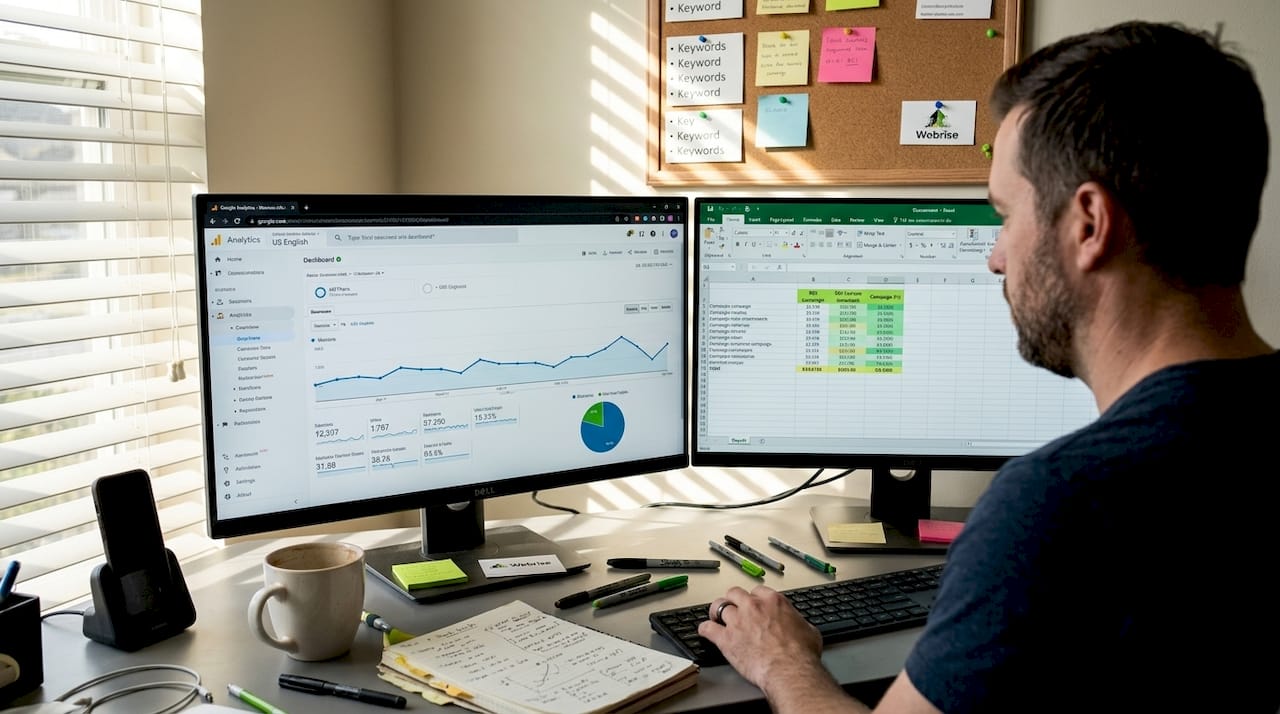
The Australian data is striking. SEO delivers 350% ROI on average, while PPC reaches 650% ROI when campaigns are well managed. AI-driven search traffic has grown over 1,200% year-over-year, though it currently accounts for only 0.1% of direct revenue share, meaning the opportunity is real but still maturing.
Here is a quick comparison of the two channels:
| Metric | SEO | PPC |
|---|---|---|
| Average ROI | 350% | 650% |
| Cost per lead (AU) | AU$45 | AU$1.75 CPC |
| Conversion rate | 8.5% | 4.2% |
| Time to results | 6-12 months | 24-48 hours |
| Sustainability | High (compounds) | Medium (stops when spend stops) |
The Google PPC CPC in Australia averages AU$1.75 with a 4.2% conversion rate, while SEO delivers a cost per lead of AU$45 and an 8.5% conversion rate. SEO wins on conversion quality; PPC wins on speed.
The main types of digital marketing all interact, but SEO and PPC form the search foundation that every other channel benefits from. When your brand ranks well organically and shows up in paid results, trust compounds fast.
Key advantages and limitations to keep in mind:
- SEO pros: Long-term compounding returns, high-quality leads, builds brand authority
- SEO cons: Slow to start, requires ongoing content and technical investment
- PPC pros: Immediate visibility, precise targeting, measurable at every step
- PPC cons: Costs rise with competition, no residual value when budget pauses
Pro Tip: Running both channels simultaneously gives you data from PPC that directly informs your SEO keyword strategy, accelerating AI marketing ROI across your entire search presence.
Content marketing and thought leadership
Once your search foundation is set, content marketing scales authority and long-term engagement.
Content marketing is not just blogging. It is the deliberate creation of valuable information that attracts, educates, and converts your target audience over time. Content marketing is a core channel for building brand authority and supporting every other channel in your mix.
The types of content that consistently perform for Australian businesses include:
- Long-form guides and blog posts that rank in search and answer real buyer questions
- Video content for social platforms, product demonstrations, and thought leadership
- Case studies and whitepapers that prove expertise to B2B buyers
- AI-generated content for scale, always reviewed and refined by a human editor
AI has changed content production dramatically. You can now produce first drafts, generate topic clusters, and repurpose content across formats in a fraction of the time. But automation without oversight creates generic, forgettable content. The brands winning with content in 2026 use AI for efficiency and humans for originality.
"The businesses that stand out are those using AI to do the heavy lifting on research and structure, while a skilled writer brings the brand voice, the nuance, and the unexpected angle that makes content actually worth reading."
Building an online presence for creators and business brands alike comes down to consistency and genuine expertise. Following best practices for online branding ensures your content reinforces your brand identity at every touchpoint.
Social media and influencer marketing
Content brings people in, but social channels amplify and engage your audience.
Social media marketing is no longer optional for Australian businesses. Social media is a key channel in the digital mix, with influencers driving measurable engagement that traditional advertising simply cannot replicate.
The platform question matters. LinkedIn is the clear choice for B2B lead generation and professional credibility. Instagram and TikTok dominate for consumer brands, lifestyle products, and younger demographics. Facebook remains strong for local business targeting and community building.
AI has made social media more precise. Tools now analyze audience behavior patterns, predict optimal posting times, and generate creative variations for A/B testing at scale. This means smaller teams can compete with much larger marketing departments.
For influencer selection, Australian brands are learning that bigger is not always better:
- Mega-influencers (1M+ followers): High reach, low engagement rates, expensive
- Macro-influencers (100K-1M): Good reach, moderate engagement, moderate cost
- Micro-influencers (10K-100K): Niche audiences, high trust, cost-effective
- Nano-influencers (1K-10K): Hyper-local, very high engagement, low cost
Pro Tip: Influencer-driven growth through micro-influencers typically delivers 3-5x better engagement rates than macro-influencer campaigns at a fraction of the cost. Using data for branding success to vet influencer audiences before committing budget is essential.
Email marketing and lifecycle automation
No digital program is complete without the stickiness and conversion power of email.
Email marketing remains one of the highest-ROI channels available to Australian businesses. Email marketing tops ROI for Australian SMEs, consistently outperforming most paid channels when automation and segmentation are done right.
The real power of email comes from lifecycle automation: sending the right message to the right person at exactly the right moment in their journey with your brand. Here is a practical sequence that works:
- Welcome series: Introduce your brand, set expectations, deliver immediate value within the first 72 hours of signup
- Nurture sequence: Educate leads with relevant content over 2-4 weeks, building trust before asking for a sale
- Conversion campaign: Targeted offer based on behavior triggers, such as page visits or content downloads
- Retention emails: Post-purchase check-ins, loyalty rewards, and product education to reduce churn
- Reactivation campaign: Re-engage subscribers who have gone quiet with a compelling reason to return
AI-powered segmentation takes this further. Instead of broad audience splits, you can now personalize content blocks based on individual behavior, purchase history, and predicted intent. The result is higher open rates, better click-throughs, and more revenue per subscriber.
"Email is the only channel where you own the audience. Social platforms change algorithms. Search rankings shift. Your email list is an asset that compounds in value every year you invest in it."
Explore proven email strategies for ROI to build sequences that convert subscribers into long-term customers.
Comparison of digital marketing types for Australian businesses
To recap and support decision-making, here is a direct comparison of the most important digital marketing types.
SEO, SEM/PPC, content, social, email, and AI-enhanced GEO are the main channels shaping Australian business results right now. The ideal performance mix is 60% brand-building and 40% direct response, with human oversight remaining critical as AI takes on more execution tasks.
| Channel | ROI potential | Speed | Best for | Key weakness |
|---|---|---|---|---|
| SEO | High (350%) | Slow | Long-term visibility | Requires patience |
| PPC/Google Ads | Very high (650%) | Fast | Immediate leads | Stops when budget stops |
| Content marketing | High (compounds) | Medium | Authority, trust | Resource-intensive |
| Social media | Medium-high | Fast | Engagement, brand | Algorithm dependency |
| Email marketing | Very high | Fast | Nurturing, retention | Requires list building |
| AI/GEO search | Emerging | Medium | Future visibility | Still maturing |
The right mix depends on your goal. If you need leads now, PPC delivers fastest. If you are building a brand that dominates your category in three years, SEO and content are non-negotiable. Email ties everything together by converting the audience you attract through every other channel.
Why AI-driven innovation won't replace marketing fundamentals
Here is the uncomfortable truth most AI marketing content glosses over: AI is a force multiplier, not a strategy.
We see Australian businesses chasing every new AI tool, convinced that automation alone will fix their marketing. It does not. The businesses generating the best long-term results are the ones using AI to execute faster on fundamentals they already understand, not replacing those fundamentals entirely.
SEO still requires genuine expertise and original thinking. Email still requires understanding your customer's real motivations. Social media still requires a brand story worth sharing. Human oversight is essential for nuanced content that actually resonates, and no AI model has replaced that yet.
The smartest investment right now is learning how to blend AI's real ROI benefits with the proven strategies that have always driven sustainable growth. Businesses that treat AI as a shortcut to skip the fundamentals will find themselves with impressive-looking dashboards and disappointing revenue results.
Original thinking, a clear brand voice, and a genuine understanding of your customer will always outperform any tool that every competitor can access equally.
Level up your marketing with expert support
You now have a clear picture of which digital marketing types deliver results and how to build a mix that fits your business goals. The next step is execution, and that is where most businesses stall.
At WebRise, we build tailored digital marketing strategies for Australian businesses from scratch, no generic templates, no cookie-cutter campaigns. Whether you need a high-performance SEO foundation, AI-powered search optimization, Google Ads that actually convert, or a full-stack marketing program, we design it around your specific goals and measure everything that matters. Book a no-obligation strategy session and find out exactly where your biggest growth opportunities are hiding.
Frequently asked questions
What are the most effective types of digital marketing for Australian businesses?
The most effective types are SEO, PPC/SEM, content marketing, social media, and email, with AI-powered GEO search emerging as a strong future channel for brands that want early-mover advantage.
How much budget should Australian SMEs allocate to digital marketing?
Australian SMEs typically invest 12-18% of revenue into digital marketing, with 30-40% of that going toward search channels like SEO and PPC.
Does AI really improve digital marketing performance?
AI traffic grew 1,200% YoY but accounts for just 0.1% of direct revenue share, and human oversight remains essential for content quality and measurable ROI.
What's the ideal digital marketing mix for maximum ROI?
Experts recommend a 60% brand-building, 40% performance split, blending proven fundamentals like SEO and email with AI-enhanced campaigns for the best long-term results.