

Running a small business in Australia while trying to figure out digital marketing can feel like throwing money into a black hole. You boost a Facebook post, nothing happens. You hire someone for SEO, and three months later you still can't find yourself on Google. The frustration is real, and it's common. Most guides either oversimplify the process or push expensive tools without explaining how they connect. This guide cuts through that noise. We're walking you through a structured, step-by-step approach to digital marketing built specifically for Australian SMBs, with AI integration baked in from the start and a clear focus on measurable ROI.
Table of Contents
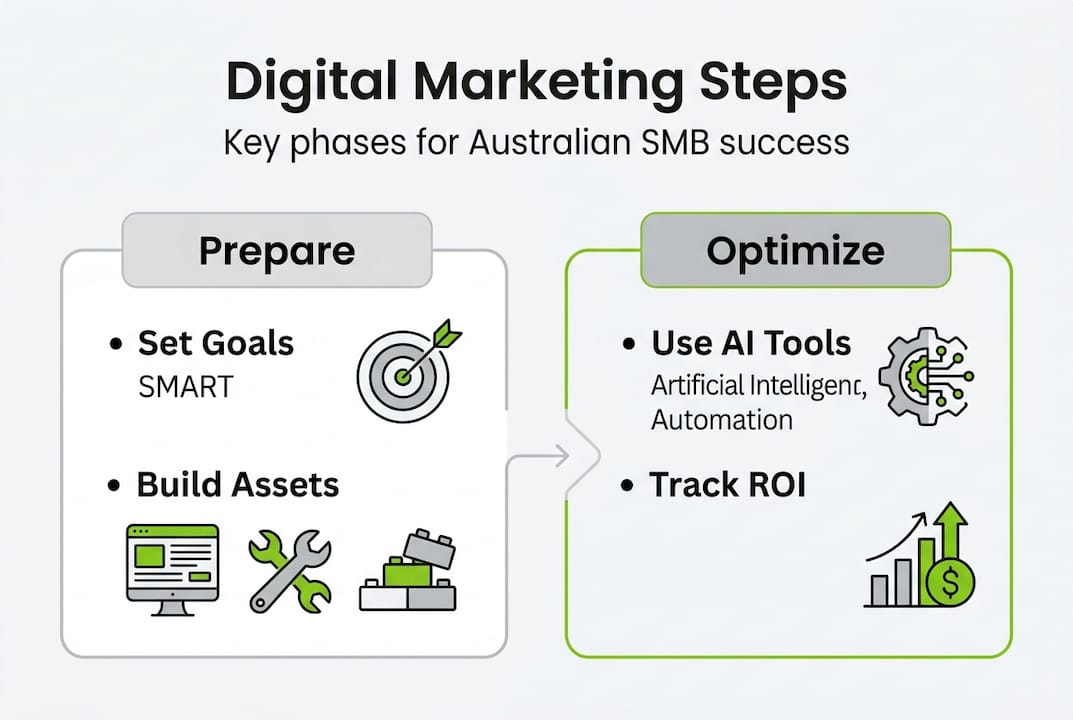
- Prepare for digital marketing success
- Step-by-step digital marketing plan for Australian SMBs
- Maximize results with AI-powered tools
- Measure ROI and optimize your marketing
- The reality of digital marketing for Australian SMBs: What most guides don't reveal
- Boost your business with expert help
- Frequently asked questions
Key Takeaways
| Point | Details |
|---|---|
| Lay strong foundations | Set SMART goals and prepare your digital assets before launching campaigns. |
| Follow a proven process | Tailored, step-by-step marketing ensures consistent progress for Australian SMBs. |
| Leverage AI tools | Integrating AI platforms saves time and improves content, ads, and analytics. |
| Track and optimize ROI | Use benchmarks and analytics to continuously improve marketing performance. |
Prepare for digital marketing success
Before you spend a single dollar on ads or content, you need a foundation. Skipping this step is exactly why most small business marketing fails. Without clear goals and the right tools in place, you're just guessing.
Start with SMART goals: Specific, Measurable, Achievable, Relevant, and Time-bound. Instead of "get more customers," try "increase website leads by 30% in 90 days." That kind of precision shapes every decision you make afterward. A step-by-step digital marketing process for Australian SMBs starts exactly here: SMART goals and solid market research.
Market research doesn't have to be expensive. Use Google Trends to spot seasonal demand in your area. Check your competitors' Google Business Profiles and read their reviews. Look at what questions your target customers are asking in Facebook groups or Reddit threads. This local intelligence is gold.
Your website and Google Business Profile (GBP) are non-negotiable starting points. A slow, outdated website will kill your conversion rate before any traffic even arrives. Your GBP needs accurate hours, photos, and regular posts to rank in local search. Think of these as your two most important storefronts.
Here's a quick overview of the key digital assets every Australian SMB needs before launching campaigns:
| Asset | Purpose | Priority |
|---|---|---|
| Website | Central hub for all traffic | Critical |
| Google Business Profile | Local search visibility | Critical |
| Google Analytics 4 | Track traffic and behavior | High |
| AI tools (ChatGPT, etc.) | Content and automation | High |
| Content calendar | Plan and organize publishing | Medium |
| CRM system | Manage leads and customers | Medium |
Before you launch anything, gather these resources:
- Your brand assets: logo, color palette, brand voice guidelines
- Competitor URLs and their top-performing content
- Customer personas based on real data, not assumptions
- A defined budget range with contingency built in
- Login access to all platforms (website, GBP, social accounts)
- A basic content calendar template
For businesses still building their brand presence, understanding the full process of building digital brand identity is a smart early investment.
Pro Tip: Set up Google Analytics 4 and your GBP on day one, even before your first campaign. The data you collect from the start will be invaluable for making smarter decisions in weeks two, four, and beyond.
Step-by-step digital marketing plan for Australian SMBs
With your foundation solid, here's how to build and run your marketing in a logical sequence. Don't skip steps or run them all at once. Each one builds on the last.
- Review and lock in your SMART goals. Revisit them weekly in the early stages.
- Optimize your website for speed and SEO. Fix technical issues, add local keywords, and make sure your site loads in under three seconds.
- Claim and optimize your Google Business Profile for local search. Local SEO and GBP optimization are foundational for visibility in Australian search results.
- Create a content plan targeting your audience's real questions. Blog posts, short videos, and social content all play a role.
- Build your email list from day one. Offer a lead magnet, a discount, or a free resource. Mastering effective email marketing is one of the highest-ROI moves a small business can make.
- Launch social media with consistency, not volume. Two strong posts a week beats seven weak ones.
- Run a small PPC test campaign on Google Ads or Meta with a defined budget. Learn before you scale.
- Integrate AI tools to speed up content creation, ad copy testing, and reporting.
- Analyze and optimize every 30 days. What's working? What's wasting budget? Adjust accordingly.
Here's how AI-powered methods compare to traditional approaches:
| Marketing task | Traditional method | AI-powered method |
|---|---|---|
| Content creation | Manual writing, hours per piece | AI drafts in minutes, human edits |
| Ad copy testing | A/B test over weeks | AI generates variations instantly |
| Analytics reporting | Manual spreadsheet pulls | Automated dashboards and insights |
| Email personalization | Generic blasts | Dynamic content based on behavior |
| Keyword research | Manual tools, slow process | AI-assisted clustering in minutes |
Pro Tip: Use AI platforms to batch-create a month's worth of social captions, email subject lines, and blog outlines in one focused session. You'll save hours every week and maintain consistency without burning out.
Maximize results with AI-powered tools
AI isn't a trend anymore. For Australian SMBs, it's quickly becoming the difference between staying competitive and falling behind. The good news is that the tools are accessible and affordable.
Here are the top AI tools worth integrating into your marketing stack:
- ChatGPT: Draft blog posts, email sequences, ad copy, and social captions in a fraction of the time
- Google Performance Max: Automates ad delivery across Search, YouTube, Gmail, and Display using AI targeting
- Surfer SEO: Analyzes top-ranking content and guides you to optimize your own pages for search
- Canva AI: Generates on-brand visuals, social graphics, and presentations without a designer
- CRM automation (e.g., HubSpot, ActiveCampaign): Triggers personalized email sequences based on user behavior
The efficiency gains are significant. Small businesses save 8+ hours per week by using AI tools for content drafting, ad management, and reporting. That's a full workday returned to you every week to focus on serving customers or growing the business.

Integration matters as much as the tools themselves. Connect your CRM to your email platform. Feed your analytics data into your content decisions. Use ChatGPT to interpret your performance reports and suggest next steps. When your tools talk to each other, you stop working in silos and start seeing the full picture.
The AI marketing benefits extend beyond time savings. AI improves targeting accuracy, personalizes customer experiences at scale, and surfaces insights that manual analysis would miss entirely.
Pro Tip: Choose AI tools that integrate with your existing platforms and can scale as your business grows. Migrating your entire marketing stack 12 months in is painful and expensive. Start with tools that grow with you.
Measure ROI and optimize your marketing
Knowing your numbers isn't optional. It's the only way to know whether your marketing is working or just looking busy.
Australian SMEs allocate 7-18% of revenue to marketing, with an average of 12%. The target ROI range sits between 3:1 and 5:1, meaning every dollar spent should return three to five dollars in revenue. That's your benchmark.
The KPIs you need to track:
- Website traffic: Total visits, source breakdown, and trends over time
- Lead volume: Form fills, calls, and chat inquiries generated
- Conversion rate: What percentage of visitors take the desired action
- Cost per acquisition (CPA): How much you spend to win one customer
- Return on ad spend (ROAS): Revenue generated per dollar of ad budget
Tools to track these metrics:
- Google Analytics 4 for website behavior and traffic sources
- Google Ads and Meta Ads Manager for paid campaign performance
- Your CRM for lead tracking and pipeline data
- Google Search Console for organic search visibility
- A simple monthly reporting dashboard (Looker Studio is free)
Here's how budget allocation and average ROAS break down by channel:
| Channel | Recommended budget share | Average ROAS |
|---|---|---|
| Search/SEO | 35-40% | Organic, compounding |
| Google Ads | Included in search | 5.2x ROAS |
| Social media (Meta) | 25% | 3.2x ROAS |
| Content marketing | 15% | Long-term, high value |
| Email marketing | 10% | High ROI, low cost |
| Other/testing | 10-15% | Variable |
The real power comes from reviewing these numbers consistently. Weekly checks catch problems early. Monthly reviews reveal patterns. Quarterly audits let you reallocate budget from underperforming channels to what's actually driving results. This cycle of review and adjustment is what separates businesses that grow from those that plateau. Explore marketing ROI benchmarks to understand what good looks like in your specific industry.
The reality of digital marketing for Australian SMBs: What most guides don't reveal
Here's what we've learned working with Australian businesses: the playbook above works, but only if you're honest about the gap between knowing and doing.
Most guides sell you on a clean, linear process. Reality is messier. Your first email campaign might flop. Your Google Ads might burn through budget before you find the right keywords. That's not failure. That's data. The businesses that win are the ones that treat every result, good or bad, as information to act on.
Local context also matters far more than most templates acknowledge. What works for a Sydney e-commerce brand won't necessarily work for a Brisbane tradie or a Melbourne café. Your audience, your competition, and your local search landscape are unique. Copying a trend from a US marketing blog without adapting it to your market is a fast way to waste time.
AI amplifies whatever strategy you bring to it. If your strategy is vague, AI will help you produce vague content faster. But when you pair AI with a clear brand voice and genuine understanding of your customer, the results compound quickly. Invest in long-term brand building as the foundation, and let AI accelerate execution on top of it.
Boost your business with expert help
If you've read this far, you understand the process. But understanding and executing are two very different things, especially when you're running a business at the same time.
At WebRise, we work with Australian small and medium businesses to build tailored digital marketing strategies from scratch, no templates, no guesswork. Our team integrates AI tools, SEO, paid media, and content into a single, cohesive system designed to drive measurable results. Whether you need help setting up your foundation or scaling what's already working, we build strategies around your goals and your market. Book a strategy session and find out exactly what's holding your growth back.
Frequently asked questions
How much should an Australian SMB spend on digital marketing?
Australian SMEs invest 7-18% of revenue in digital marketing, with 12% being the average. Your exact figure should reflect your growth stage and competitive landscape.
What are the most effective first steps for small businesses starting digital marketing?
Begin by setting SMART goals, then optimize your website and Google Business Profile for local SEO. A targeted content plan built around your audience's real questions is the next priority.
How does using AI help small businesses with digital marketing?
AI tools save 8+ hours weekly by automating content creation, ad management, and reporting, freeing you to focus on strategy and customer relationships.
Which digital marketing channels drive the best ROI for SMBs in Australia?
Google Ads and Meta consistently deliver strong returns, with ROAS of 5.2x and 3.2x respectively, making them the top paid channels for Australian SMBs.