

Organic reach sounds appealing until you realize how slow it actually is. While SEO and content marketing build long-term momentum, paid media can put your brand in front of the right audience today. Australian businesses are already capitalizing on this, with PPC ROI averaging 650% and national ad spend projected to hit AUD 4.2 billion in 2026. If you're still treating paid media as optional, you're likely leaving serious revenue on the table. This article breaks down exactly what paid media is, which channels deliver results for Australian businesses, how to measure performance, and how to launch campaigns that actually work.
Table of Contents
- Defining paid media and its role in marketing
- Types of paid media: Channels, formats, and examples
- How paid media delivers value: ROI, cost, and measurement
- Getting started: Steps to launch effective paid media campaigns
- A smarter approach: Lessons from Australian paid media campaigns
- Ready to boost your brand with expert paid media?
- Frequently asked questions
Key Takeaways
| Point | Details |
|---|---|
| Paid media accelerates growth | Australian businesses can expect measurable ROI and fast visibility using search and social ads. |
| Multiple channels boost results | Combining paid, owned, and earned media delivers stronger and more sustainable marketing outcomes. |
| Measurement is critical | Tracking CPC, ROAS, and conversion rates helps maximize your paid media investment. |
| Smart strategy matters most | Start with clear goals, creative testing, and brand alignment for lasting paid media success. |
Defining paid media and its role in marketing
Paid media is any digital exposure you pay for directly. Search ads that appear when someone Googles your service, sponsored posts on Instagram, display banners on news sites, and video pre-rolls on YouTube are all paid media. The common thread is simple: you pay for placement, and you get visibility in return.
To understand where paid media fits, it helps to know the PESO framework. PESO stands for Paid, Earned, Shared, and Owned media. Each type plays a different role:
- Paid media gives you immediate, targeted reach in exchange for budget.
- Earned media is coverage you get through PR, reviews, or word of mouth.
- Shared media includes social engagement and community-driven content.
- Owned media is your website, blog, and email list, content you control entirely.
The PESO model works best when these four types support each other. As the PESO framework makes clear, you should start with owned content as your foundation and amplify it through paid channels, but paid channels drive quick wins and still require a retention focus to deliver lasting value.
Here's how the four types compare at a glance:
| Type | Control | Speed | Investment | Primary outcome |
|---|---|---|---|---|
| Paid | High | Fast | Budget required | Immediate traffic |
| Earned | Low | Slow | Time and effort | Credibility |
| Shared | Medium | Medium | Community effort | Engagement |
| Owned | Full | Slow | Content creation | Long-term authority |
Paid media wins on speed and control. You set the audience, the message, the budget, and the timing. No waiting for Google to index a blog post or hoping a journalist picks up your story. For businesses that need results now, whether launching a product, running a promotion, or entering a new market, paid media is the fastest lever available.
That said, paid media alone is not a complete strategy. Without owned content to send traffic to and email marketing strategies to nurture leads afterward, you're paying to fill a leaky bucket. The smartest approach uses paid media to accelerate what you've already built.
Paid media is the accelerant, not the engine. Without a solid content foundation, you're spending money to drive traffic that has nowhere meaningful to go.
Types of paid media: Channels, formats, and examples
The paid media landscape has expanded well beyond Google search ads. Today, Australian businesses have access to a wide range of channels and formats, each suited to different goals and audiences.
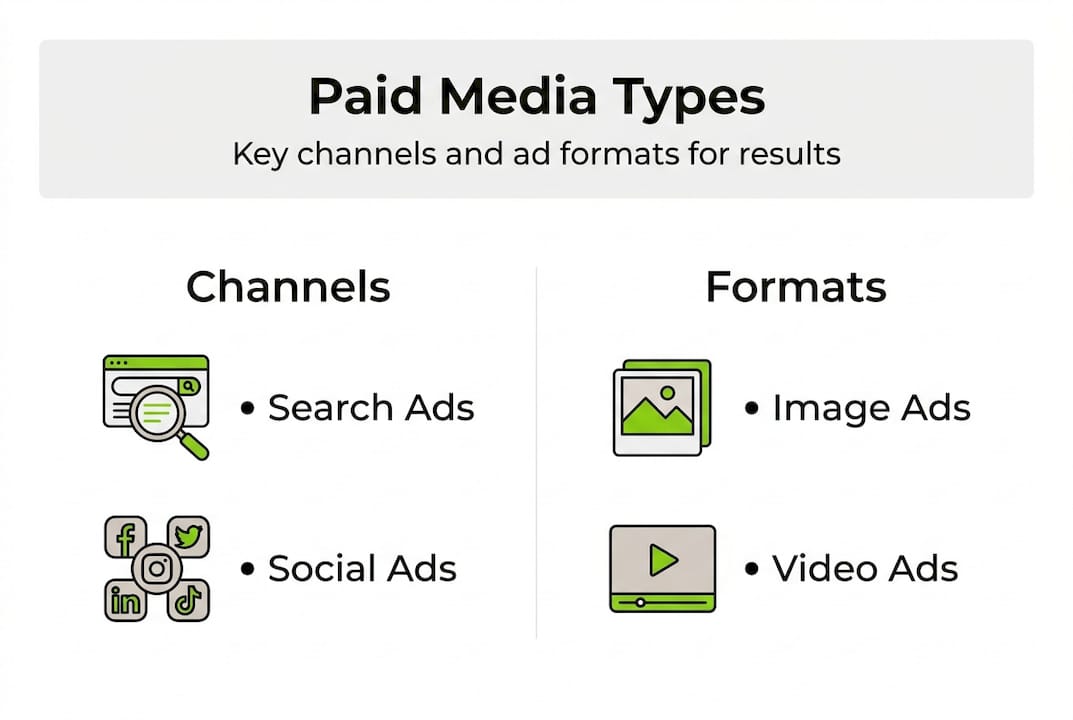
The major paid media channels include:
- Google Search Ads: Text ads triggered by specific keywords. Ideal for capturing high-intent buyers actively searching for your product or service.
- Meta Ads (Facebook and Instagram): Visual ads with powerful audience targeting based on demographics, interests, and behavior.
- Display Advertising: Banner and image ads placed across websites in Google's Display Network or other ad networks.
- Video Ads: Pre-roll or mid-roll ads on YouTube or social platforms. Strong for brand awareness and storytelling.
- Native Advertising: Sponsored content that blends into editorial environments, like promoted articles on news sites.
- Influencer Partnerships: Paid collaborations with content creators who promote your brand to their audience.
For Australian SMEs, some platforms consistently outperform others. Google Search delivers 3x to 5x returns, while Meta Ads average 3.2x return on ad spend, making both strong starting points.
| Channel | Avg. Australian ROI | Avg. CPC (AUD) | Typical use case |
|---|---|---|---|
| Google Search | 3x to 5x | $2.10 | Lead generation, direct sales |
| Meta Ads | 3.2x | $1.20 | Brand awareness, retargeting |
| YouTube Ads | 2.5x to 4x | $0.10 to $0.30 per view | Product launches, storytelling |
| Display Ads | 1.5x to 2.5x | $0.50 | Retargeting, brand recall |
Format matters as much as channel. A static image ad on Instagram behaves very differently from a search ad. Video builds emotion. Search captures intent. Display reinforces memory. Understanding which format fits your goal prevents wasted spend.
Integrating AI marketing benefits into your paid campaigns can also sharpen targeting and automate bidding, giving you a meaningful edge over competitors still running manual campaigns.
Pro Tip: Rotate your ad creative every two to three weeks. Ad fatigue is real, and audiences tune out repetitive visuals quickly. Fresh creative keeps click-through rates healthy and costs down.
How paid media delivers value: ROI, cost, and measurement
Knowing your numbers is what separates businesses that scale paid media from those that burn through budget and give up. Four metrics matter most:
- CPC (Cost Per Click): What you pay each time someone clicks your ad.
- CPM (Cost Per Thousand Impressions): What you pay for every 1,000 times your ad is shown.
- Conversion Rate: The percentage of clicks that result in a desired action, like a purchase or form submission.
- ROAS (Return on Ad Spend): Revenue generated for every dollar spent on ads.
Australian benchmarks give you a useful baseline. The average CPC in Australia sits at AUD 1.75, with a 4.2% conversion rate and a typical ROAS of 3x to 5x for search campaigns. If your numbers fall significantly below these, it's a signal to investigate your targeting, creative, or landing page.
Here's a practical process for measuring and optimizing your campaigns:
- Set clear goals before you spend. Are you driving sales, leads, or awareness? Your goal determines which metrics to prioritize.
- Install proper tracking. Use Google Tag Manager and conversion tracking from day one. Flying blind on attribution is one of the most expensive mistakes in paid media.
- Establish your baseline. Run campaigns for at least two to four weeks before drawing conclusions. Early data is often noisy.
- Compare against benchmarks. Use Australian averages as a reference point, not a ceiling.
- Optimize in cycles. Adjust bids, test new audiences, and refresh creative based on what the data tells you, not gut feel.
Focusing on achieving higher marketing ROI means looking beyond the immediate cost per lead. A lead that costs AUD 50 but converts to a AUD 5,000 client is far more valuable than a AUD 10 lead that never buys again.

Pro Tip: Calculate customer lifetime value before setting your target cost per acquisition. A business with high repeat purchase rates can afford to pay more per lead than a one-time transaction business.
Getting started: Steps to launch effective paid media campaigns
Launching paid media without a plan is how businesses waste their first AUD 5,000. A structured approach makes the difference between a campaign that teaches you something and one that just drains your account.
Follow these steps to launch effectively:
- Define your goal. Sales, leads, app installs, or brand awareness each require a different campaign structure. Be specific.
- Choose your platform. Match the channel to where your audience spends time. B2B businesses often do better on LinkedIn or Google. B2C brands typically find stronger returns on Meta or YouTube.
- Set a realistic budget. Australian SMEs typically allocate 12 to 18% of revenue to digital marketing, with paid media as the primary driver for rapid gains. Start with enough to gather data, usually AUD 1,500 to AUD 3,000 per month minimum.
- Develop your creative. Write ad copy that speaks to a specific problem your audience has. Use visuals that stop the scroll. Test at least two to three variations from the start.
- Launch and monitor. Check performance daily in the first two weeks. Watch for anomalies like unusually high CPCs or low click-through rates.
- Iterate based on data. Kill what's not working. Scale what is. Repeat every two to four weeks.
Common pitfalls to avoid:
- Targeting too broadly and wasting budget on unqualified audiences
- Sending paid traffic to a homepage instead of a dedicated landing page
- Ignoring mobile optimization when over 60% of Australian ad clicks happen on mobile devices
- Stopping campaigns too early before the algorithm has enough data to optimize
- Neglecting building a digital brand identity that makes your ads credible and recognizable
Paid media works best when it's part of a broader system. Your ads, your landing pages, your follow-up emails, and your brand all need to tell a consistent story.
A smarter approach: Lessons from Australian paid media campaigns
Here's something the industry rarely admits: more budget does not fix a broken strategy. We've seen businesses pour AUD 20,000 a month into Google Ads and generate almost nothing because their landing pages were weak, their offer was unclear, or their audience targeting was too broad. Spending more just accelerates the leak.
The businesses that consistently see strong real-world marketing results share one trait: they treat paid media as part of a system, not a standalone tactic. Their ads connect to strong landing pages. Their landing pages connect to email sequences. Their brand is clear and consistent across every touchpoint.
What most paid media advice also misses is the value of creative velocity. The brands winning in 2026 are not the ones with the biggest budgets. They're the ones testing new angles, new formats, and new messages faster than their competitors. The ad market moves quickly. What worked six months ago may be invisible today.
Our honest take: paid media is powerful, but only when it's built on a solid brand and backed by content that earns trust. Without that foundation, you're renting attention instead of building an audience.
Ready to boost your brand with expert paid media?
Paid media done right is one of the fastest ways to grow your business visibility and revenue in the Australian market. But it requires the right strategy, the right creative, and consistent optimization to deliver the returns the data promises.
At WebRise, we build paid media campaigns from scratch, tailored to your business goals and the Australian market. No generic templates. No guesswork. Just data-driven strategies designed to generate measurable results. If you're ready to put your budget to work smarter, get expert help from WebRise and find out what a properly structured paid media campaign can do for your growth.
Frequently asked questions
What is paid media and how does it differ from organic marketing?
Paid media refers to any online exposure you pay for directly, such as search ads, display banners, or sponsored posts, while organic marketing relies on content, SEO, or engagement earned without direct ad spend. The PESO framework recommends building owned content first, then amplifying it through paid channels for faster reach.
What is a good ROI for paid media in Australia?
Australian businesses can expect a 3x to 5x return on search ad spend and around 3.2x on Meta Ads, with well-optimized campaigns reaching 650% PPC ROI in some cases. Your actual ROI will depend on your industry, offer, and how well your campaign is structured.
How much should Australian businesses budget for paid media marketing?
Most Australian SMEs invest 12 to 18% of their revenue in digital marketing, with paid media driving the fastest measurable gains. A practical starting point for most businesses is AUD 1,500 to AUD 3,000 per month to gather meaningful data.
How do you measure paid media campaign success?
Track ROAS, CPC, CPM, and conversion rate as your core metrics, and compare them against Australian benchmarks like the average CPC of AUD 1.75 and a 4.2% conversion rate to evaluate whether your campaigns are performing competitively.