

Many Australian business owners assume marketing automation is reserved for large enterprises with deep pockets and dedicated tech teams. That assumption is costing them revenue. The reality is that modern automation tools, now supercharged by AI, are accessible to businesses of every size and are actively reshaping how smart marketers generate leads, retain customers, and measure results. This article walks you through what marketing automation actually is, how it works across your funnel, where it goes wrong, and how to implement it the right way. Whether you're running a boutique consultancy in Melbourne or a growing e-commerce brand in Sydney, the frameworks here apply directly to you.
Table of Contents
- What is marketing automation and why does it matter?
- How automation transforms your marketing funnel
- Balancing automation and personalization: Avoiding common pitfalls
- Best practices: Choosing, implementing, and optimizing automation tools
- Why successful marketing automation is more than just technology
- Ready to elevate your marketing? Let's partner for success
- Frequently asked questions
Key Takeaways
| Point | Details |
|---|---|
| Automation’s real value | Leveraging automation boosts marketing efficiency, consistency, and ROI for all business sizes. |
| Balance technology and human touch | Effective automation requires ongoing human oversight and personalization to avoid customer churn. |
| Data quality is critical | Good data fuels success while bad data leads to costly automation errors. |
| Best practices matter | A strategic, step-by-step approach ensures you select and implement the right tools for sustainable results. |
What is marketing automation and why does it matter?
Marketing automation is software that handles repetitive marketing tasks on your behalf, triggered by rules, user behavior, or AI-driven signals. Think of it as a system that watches how your audience behaves and responds at the right moment, without you having to lift a finger each time.
At its core, marketing automation encompasses lead nurturing, customer segmentation, campaign management, and performance analytics, and it has evolved from basic rule-based workflows into AI-powered, self-optimizing systems. That evolution matters. Early automation was rigid. If a contact clicked a link, they got email B. If they didn't, they got email C. Today's systems learn from patterns and adjust in real time, which means your campaigns get smarter the longer they run.
Here's why this matters for Australian SMEs specifically. The barrier to entry has dropped dramatically. Platforms like HubSpot, ActiveCampaign, and Klaviyo now offer tiered pricing that suits businesses with a few hundred contacts, not just corporate databases with millions. The AI benefits in marketing extend well beyond big-brand budgets now.
Key benefits of marketing automation:
- Efficiency: Automate repetitive tasks like follow-up emails, social scheduling, and lead scoring so your team focuses on strategy.
- Consistency: Every prospect receives the right message at the right time, without human error or delays.
- Scalability: Handle 10 leads or 10,000 with the same system and the same quality of communication.
- Data-driven decisions: Built-in analytics reveal what's working, so you stop guessing and start optimizing.
- Better ROI: Less wasted spend, higher conversion rates, and improved customer lifetime value.
| Business size | Primary automation benefit | Common starting point |
|---|---|---|
| Solo operator | Time savings on follow-ups | Email autoresponders |
| Small business (2-20 staff) | Lead nurturing at scale | CRM with workflow automation |
| Mid-market (20-200 staff) | Segmentation and personalization | Full marketing platform |
| Enterprise | Predictive analytics and AI optimization | Integrated AI-driven suite |
"The shift from rule-based to AI-driven automation isn't just a tech upgrade. It's a fundamentally different relationship between your brand and your customer, one that responds rather than broadcasts."
For Australian SMEs, this shift levels the playing field. You no longer need an in-house marketing team of ten to run sophisticated, personalized campaigns. You need the right system and a clear strategy.
How automation transforms your marketing funnel
Your marketing funnel moves prospects from strangers to loyal customers through four core stages: awareness, consideration, conversion, and retention. Automation plays a specific and powerful role at each one.
Marketing automation encompasses the tools that make each stage faster, more targeted, and more measurable. Here's how the mapping works in practice.
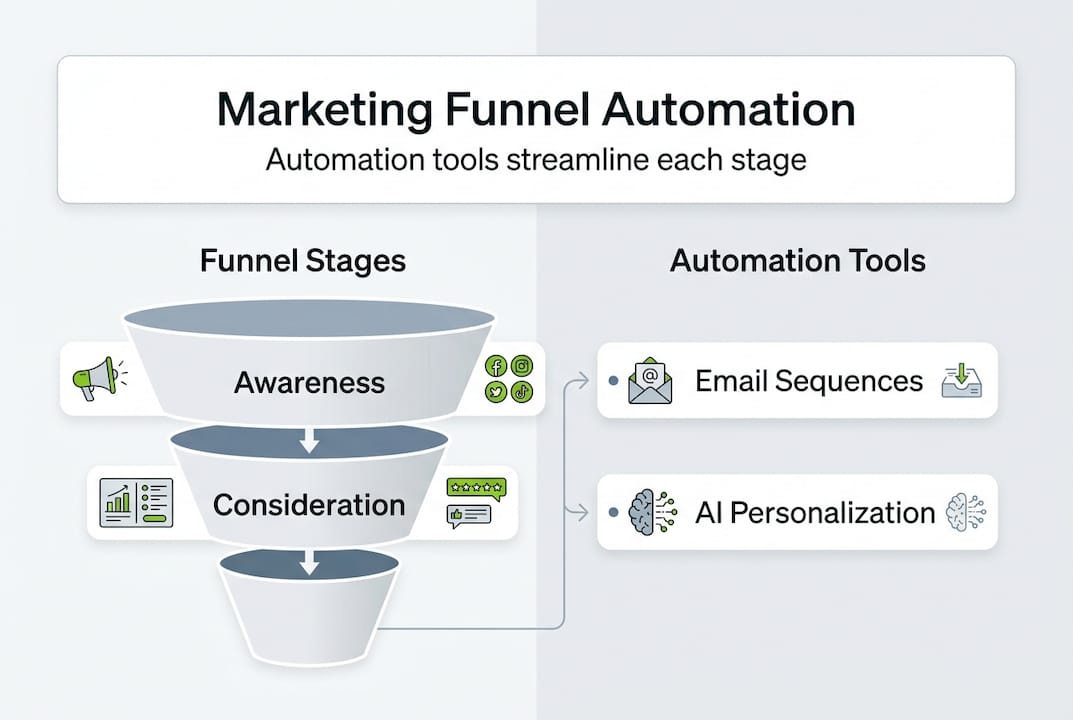
| Funnel stage | Automation tool | What it does |
|---|---|---|
| Awareness | Social scheduling, paid ad retargeting | Keeps your brand visible without manual daily effort |
| Consideration | Lead scoring, targeted email sequences | Moves warm leads closer to a decision |
| Conversion | Abandoned cart emails, dynamic landing pages | Recovers lost revenue and personalizes the offer |
| Retention | Loyalty triggers, re-engagement campaigns | Keeps existing customers active and buying |
A typical automated campaign journey looks like this:
- A prospect downloads your free guide from a landing page, triggering their entry into your CRM.
- They receive a welcome email within minutes, not hours, with relevant next steps tailored to the guide topic.
- Their behavior is tracked. Did they open the email? Click a link? Visit a pricing page? Each action adjusts their lead score.
- High-scoring leads receive a targeted follow-up with a case study or testimonial relevant to their industry.
- A low-scoring lead gets re-engaged two weeks later with a different angle, perhaps a webinar invite or a how-to resource.
- Converted customers enter a retention flow, receiving onboarding tips, usage prompts, and loyalty offers.
This is where email automation strategies prove their value most clearly. A Sydney-based HR software company, for example, used a six-step automated email sequence to increase their qualified lead rate by 34% in three months, with no additional ad spend.
Pro Tip: Automate the touchpoints that are repetitive and timing-sensitive, like welcome emails and cart abandonment. Keep complex sales conversations, onboarding calls, and high-value client check-ins human-led. The personal touch still closes deals that automation can only warm up.
AI-driven personalization takes this further by dynamically adjusting subject lines, product recommendations, and send times based on individual behavior patterns. This is where modern automation moves from efficient to genuinely powerful.

Balancing automation and personalization: Avoiding common pitfalls
Automation can go wrong fast if you treat it as a set-and-forget solution. The most common mistake is over-automating, which strips away the human feeling that makes your brand trustworthy.
Over-automation risks include reduced customer lifetime value and churn from a lack of human touch. Critically, 64% of automation projects fail due to poor data quality. That's not a technology problem. It's a data hygiene and strategy problem.
When your database has outdated contacts, incorrect segments, or missing behavioral data, your automated messages land wrong. You send a re-engagement email to someone who just made a purchase. You trigger a discount offer to your highest-value customer who never needed a discount to buy. These errors erode trust quickly.
Signs you may be over-automating:
- Email open rates and click rates are dropping month over month.
- Unsubscribe rates are climbing without a clear external cause.
- Customers are complaining that your communication feels robotic or irrelevant.
- Sales reps report that leads seem confused or put off before the first conversation.
- Your sequences run for months without any human review or adjustment.
Building AI branding for SMBs means recognizing that AI amplifies your brand's voice. If the underlying strategy or data is flawed, automation amplifies those flaws too.
Pro Tip: Treat automation as a support structure, not a replacement for real relationships. Set a monthly review cadence where a real person audits key automated sequences, checks engagement signals, and identifies where a personal outreach might replace a triggered email.
Checklist for blending automation with personal marketing:
- Audit your contact database every quarter for outdated or duplicate records.
- Segment lists based on real behavior, not just demographic assumptions.
- Include genuine personalization tokens (name, company, last purchase) in every automated message.
- Build manual review points into any sequence longer than three emails.
- Monitor engagement metrics weekly, not just quarterly.
- Allow contacts to update their own preferences so you're always sending what they want.
The goal isn't less automation. It's smarter automation that feels human even when it isn't.
Best practices: Choosing, implementing, and optimizing automation tools
Choosing the wrong tool is one of the most expensive mistakes a marketing team can make. The wrong platform creates integration headaches, poor data flow, and eventual abandonment. Here's a practical framework for getting it right.
"Poor data doesn't just hurt your results. It actively works against them. Every automated message sent to the wrong segment increases unsubscribes, decreases deliverability, and trains your audience to ignore you."
Maintaining human feedback loops and keeping communication transparent are non-negotiable for avoiding the alienation that sinks automation projects.
Steps for a successful automation rollout:
- Define your goals first. Are you focused on lead volume, conversion rate, or customer retention? Your goal determines the tool and the workflow.
- Audit your existing data. Before importing anything, clean your lists. Remove duplicates, correct errors, and fill in critical missing fields.
- Start with a pilot. Pick one workflow, such as a welcome sequence or abandoned cart recovery, and run it for 30 days before scaling.
- Measure relentlessly. Track open rates, click rates, conversion rates, and unsubscribes from day one. Establish a baseline.
- Refine before expanding. Only add new automated workflows once the first is performing consistently. Complexity compounds problems as well as results.
- Build in human review points. Schedule monthly audits of your sequences, not just the numbers but the actual content and logic.
Features to prioritize when evaluating tools:
- Native CRM integration or built-in CRM functionality.
- AI-driven send-time optimization and personalization.
- Robust segmentation with behavioral triggers, not just list-based targeting.
- Clear analytics dashboards with attribution reporting.
- Scalable pricing that grows with your contact list.
- Local support options or active user communities in Australia.
For AI-driven marketing ROI, the ongoing optimization loop matters as much as the initial setup. A Brisbane-based retail brand found that by refining their post-purchase automation sequence over 90 days, they increased repeat purchase rates by 28% without changing their ad budget at all.
Why successful marketing automation is more than just technology
After working across dozens of Australian businesses, one pattern stands out clearly: the businesses that fail at automation almost never fail because of the tool they chose. They fail because of mindset.
The expectation of "set and forget" is the single biggest driver of poor automation outcomes. Business owners invest in a platform, build a few sequences, and then move on to the next priority. Six months later, they're wondering why their leads aren't converting.
Automation is an ongoing process, not a one-time project. Your audience changes. Your market shifts. The messages that worked in January may feel stale by June. Continuous data improvement and team alignment are far more valuable than having the most sophisticated tool on the market.
Here's the contrarian view worth sitting with: sometimes less automation delivers better engagement. Sending fewer, more intentional messages to a tightly segmented audience consistently outperforms high-volume, broadly automated campaigns. We've seen businesses cut their email frequency in half and watch engagement double. Learning from AI case studies reinforces this. The brands winning with AI aren't always the ones automating the most. They're the ones automating with the most precision.
Technology is the enabler. Strategy, curiosity, and commitment to improvement are what make it work.
Ready to elevate your marketing? Let's partner for success
If you're ready to take the next step and get automation working for your business, the difference between average results and exceptional ROI often comes down to expert guidance. Knowing which tools to use, how to integrate them properly, and how to optimize over time takes experience that most internal teams are still building.
At WebRise, we work with Australian business owners and marketing teams to design, implement, and refine automation strategies built around your specific goals, not generic templates. From tool selection and data setup to ongoing performance reviews, we help you get more from every marketing dollar. If you're serious about results, connect with our digital marketing automation experts and let's build something that actually works for your business.
Frequently asked questions
What types of marketing tasks can be automated?
Lead nurturing, segmentation, email campaigns, and performance analytics are among the most commonly automated marketing tasks. Social media scheduling and paid ad retargeting can also run on automation effectively.
How does automation improve marketing ROI?
Automation reduces wasted time on repetitive tasks, improves message timing and relevance, and provides data that shows you exactly where to optimize. The result is lower cost per acquisition and higher customer lifetime value.
What should I avoid when implementing marketing automation?
Avoid building sequences on poor data and resist the urge to automate every interaction. 64% of projects fail due to data quality issues, and over-automation can drive customers away faster than no automation at all.
How do I choose the best marketing automation tool for my business?
Start by mapping your specific goals and existing tech stack, then evaluate tools based on integration capability, AI features, segmentation depth, and scalable pricing that fits where your business is now and where it's headed.
Recommended
- Email marketing strategies that drive 122% higher ROI
- Top benefits of AI in marketing for maximum ROI
- Build a digital brand identity: AI guide for SMBs
- WebRise — Digital Marketing Agency Sydney
- How to transform your website to generate more leads?
- Digital marketing ROI metrics for South African SMEs