

Running a small or medium business in Australia means wearing a dozen hats at once. Marketing often gets squeezed into whatever time is left, which usually isn't much. The good news is that AI marketing tools have matured to the point where they're genuinely accessible, even for teams of two or three people with no dedicated marketer. One Sydney café owner saved 8 hours a week using just ChatGPT, Canva AI, and Zapier for around AU$50 per month. This guide walks you through every stage of building your own AI-driven marketing workflow, from picking the right tools to measuring real business results.
Table of Contents
- Assess your readiness and choose the right AI tools
- Step-by-step: Implementing your first AI-driven marketing workflow
- Common pitfalls and how to avoid them
- Measuring results and scaling your AI-driven strategy
- What most guides miss about AI-driven marketing for SMBs
- Get support for your AI-driven marketing journey
- Frequently asked questions
Key Takeaways
| Point | Details |
|---|---|
| Start small with AI | Begin with one or two affordable tools and pilot on a single channel to avoid overwhelm. |
| Human oversight needed | Always review AI-generated content to ensure it fits your brand and is accurate. |
| Measure and adapt | Track results and tweak your AI process to maximize your marketing returns. |
| Integration is key | Plan for tool compatibility and staff training to smooth the adoption process. |
Assess your readiness and choose the right AI tools
Before you download anything or enter a credit card number, take ten minutes to assess where you actually stand. What's eating the most of your marketing time right now? Is it writing social captions, responding to reviews, designing graphics, or tracking ad performance? Pinpoint one or two bottlenecks before you start shopping for tools.
Here's a quick readiness checklist:
- Basic digital presence — You have a website and at least one active social or Google Business profile
- Data access — You can pull simple metrics like page views, email open rates, or follower growth
- Tech-comfortable staff — At least one person can follow a tutorial and test a new platform
- Clear channel goal — You know whether you're starting with content, email, ads, or review management
Once you've checked those boxes, you can match tools to your specific gap. The table below covers the three most practical AI marketing tools for Australian SMBs in 2026:
| Tool | Best for | AU pricing | Ease of use |
|---|---|---|---|
| ChatGPT | Content writing, email copy, review replies | AU$28/mo | Easy |
| Canva AI | Social graphics, brand templates, video | AU$22/mo | Very easy |
| Zapier | Workflow automation, posting triggers, alerts | AU$0 free tier | Moderate |
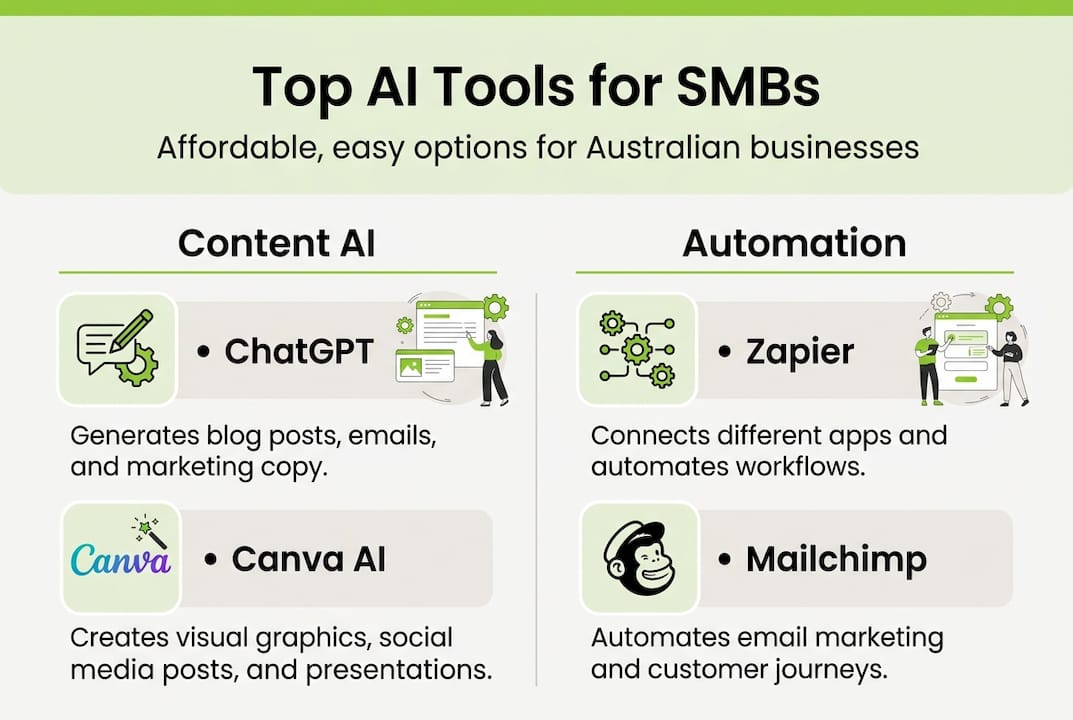
For most SMBs, prioritizing low-cost tools like ChatGPT at AU$28 per month and Canva AI at AU$22 per month is the smartest way to start without overcommitting budget. Together they cover the two biggest time sinks: writing and design.
One important reality check: human oversight and data quality are critical when using any AI tool. AI output needs a human review pass to ensure it sounds like your brand, not a generic template. Poorly labeled customer data fed into an AI tool will produce equally poor personalization. Garbage in, garbage out.
For a broader picture of where AI adoption in Australian marketing is heading, the trends strongly favor businesses that start learning now rather than waiting until the market forces the change.
Pro Tip: Start with a single funnel. If you sell locally, begin with Instagram content generation using ChatGPT plus Canva AI. Master that before layering in email automation or paid media. Fragmentation kills momentum for small teams.
Step-by-step: Implementing your first AI-driven marketing workflow
Now that you know what tools to use and how to prepare, it's time to look at the step-by-step process in action. This six-step framework is based on how real Australian SMBs get their first AI workflow running without burning a weekend.
- Define your target audience and channel. Write one sentence describing your ideal customer and pick one channel, such as Instagram, email, or Google Business. Specificity here makes every AI output more relevant.
- Set up your chosen tool. Create your account, complete the onboarding, and connect any integrations (for example, link Canva to your Instagram account). Spend one hour here, not five.
- Generate and edit content. Use ChatGPT to draft five posts or email subject lines. Then edit them to match your brand voice, add a local reference, and check for accuracy.
- Integrate with your workflow. Connect Canva AI to your ChatGPT drafts so copy and design stay in sync. Use Zapier to trigger posts at scheduled times or send you alerts when a new review lands.
- Review AI outputs for accuracy and brand voice. This step is non-negotiable. Read every piece before it goes live. AI gets tone wrong, misquotes facts, and occasionally produces generic filler.
- Schedule, publish, and monitor results. Set a two-week review cadence to check engagement, click-throughs, and time saved.
The time savings are significant once the workflow is running. A Sydney café owner using ChatGPT for Instagram captions and review replies, Canva AI for graphics, and Zapier for automation alerts saved 8 hours a week at a total cost of roughly AU$50 per month. Many of our success stories of AI marketing show similar gains across retail, hospitality, and professional services.

| Task | Manual process | AI-driven process |
|---|---|---|
| Write 5 Instagram captions | 2 hours | 20 minutes |
| Design 5 branded graphics | 3 hours | 30 minutes |
| Reply to 10 Google reviews | 1.5 hours | 15 minutes |
| Schedule a month of posts | 2 hours | 30 minutes |
Pro Tip: Zapier's free tier allows up to 100 automated tasks per month. Set a trigger that notifies you every time a new Google review comes in so you can respond within the hour. Fast responses directly improve your local search ranking.
Common pitfalls and how to avoid them
With your first workflow in place, it's important to be aware of common challenges so you can sidestep them from the start. Most AI marketing failures aren't technology failures. They're process failures.
Here are the most common issues Australian SMBs run into:
- Integration headaches — Tools don't always talk to each other cleanly, especially when connecting older booking or POS systems
- Lack of team training — Staff who don't understand how to prompt AI tools produce poor outputs and lose confidence fast
- Over-reliance on AI — Publishing AI content without review leads to factual errors, generic tone, and potential compliance issues
- Poor data quality — Outdated customer lists or incomplete profiles make AI personalization useless
- Off-brand content — AI defaults to neutral, professional language that might not match your voice at all
"AI tools are powerful assistants, but they have no idea what makes your brand uniquely yours. Human oversight isn't optional. It's the difference between content that builds trust and content that erodes it."
The numbers back this up. Integration challenges affected 47% of SMBs, and 54% reported that staff training was a significant barrier to effective AI use. Human review is the single most important step you can add to any AI workflow.
Practical solutions include running a two-week pilot before committing to a full rollout, assigning one team member as your AI quality reviewer, scheduling a monthly content audit, and booking a 30-minute team training session each quarter. For detailed integration best practices, these steps scale well regardless of your business size.
Measuring results and scaling your AI-driven strategy
After avoiding the main pitfalls, let's see how you can measure the impact of your efforts and determine when and how to expand. Measurement doesn't need to be complicated. In fact, simpler metrics tend to get tracked more consistently.
Start by tracking these four categories:
- Time saved — Log actual hours spent on marketing tasks before and after AI implementation
- Engagement rates — Likes, comments, shares, and email opens show whether your content is resonating
- Content output volume — Are you publishing more consistently? Consistency compounds over months
- ROI per tool — Divide the monthly cost of each tool by the measurable output or leads it contributed
Here's where the opportunity gets interesting. Australia currently lags the global average in AI adoption, with only 65% of Australian businesses investing in AI compared to 84% globally. That gap is your competitive window. SMBs that build AI-driven marketing systems now will have a significant head start over competitors who wait another year.
Once your pilot channel is running smoothly and you can see the numbers improving, expand to a second channel. For most SMBs, the progression looks like this: Instagram content first, then email automation, then Google Ads optimization, then multi-channel scheduling. Businesses that align their marketing and IT functions see measurably better scaling outcomes because the tools, data, and people are working from the same playbook.
Set a simple quarterly review: Is each tool saving more time than it costs? Is engagement trending up? If yes to both, expand. If not, adjust the process before adding more tools.
What most guides miss about AI-driven marketing for SMBs
Most AI marketing guides are written from the perspective of large marketing teams with dedicated specialists, healthy budgets, and months to experiment. They're not written for the business owner answering phones, managing staff, and trying to post on Instagram before dinner.
Here's the uncomfortable reality: tool overload is just as dangerous as doing nothing. Every new subscription adds a learning curve, a billing line, and another system to maintain. The SMBs we see getting real SMB marketing results aren't using ten tools. They're using two or three tools with discipline and consistency.
AI is a force multiplier, not a replacement for strategy. It amplifies whatever you feed it. A weak content strategy automated with AI just produces weak content faster. The businesses winning with AI in Australia right now started with a clear audience, a specific channel, and realistic expectations. They kept humans in the loop. They reviewed outputs. They measured what mattered. That's the real playbook.
Get support for your AI-driven marketing journey
If you want help putting these steps into action or want to accelerate your AI-driven marketing results, here's your next move.
Putting together an AI marketing workflow sounds straightforward in a guide, but the details get complex fast, especially when you're balancing tools, brand voice, compliance, and growth targets at the same time.
WebRise works with Australian SMBs at every stage of the AI marketing journey, from first-tool selection to full AI marketing solutions for Australian SMBs including SEO, content strategy, paid media, and automation. If you'd rather skip the trial-and-error phase and get a strategy built specifically for your business, our Sydney-based team is ready to help you move faster and smarter.
Frequently asked questions
What's the best first AI tool for small businesses in Australia?
ChatGPT for content creation or Canva AI for graphics are cost-effective, easy to start, and built for common SMB needs. Both tools are accessible at AU$28 and AU$22 per month respectively, making the entry cost low enough to test before committing.
How much time can AI save me each week?
Australian SMBs have reported saving up to 8 hours per week with simple content and automation workflows. Results vary based on how many tasks you automate and how consistently you use the tools.
Are there risks with AI marketing tools?
Risks include off-brand content, data privacy issues, and poor integration, so human oversight is essential. Integration challenges affect 47% of SMBs, which makes a careful pilot phase the smartest way to launch.
How do I know if my AI marketing is working?
Track simple metrics like time saved, engagement rates, and cost per lead to assess progress. If those numbers improve month over month, your AI workflow is delivering real value.